
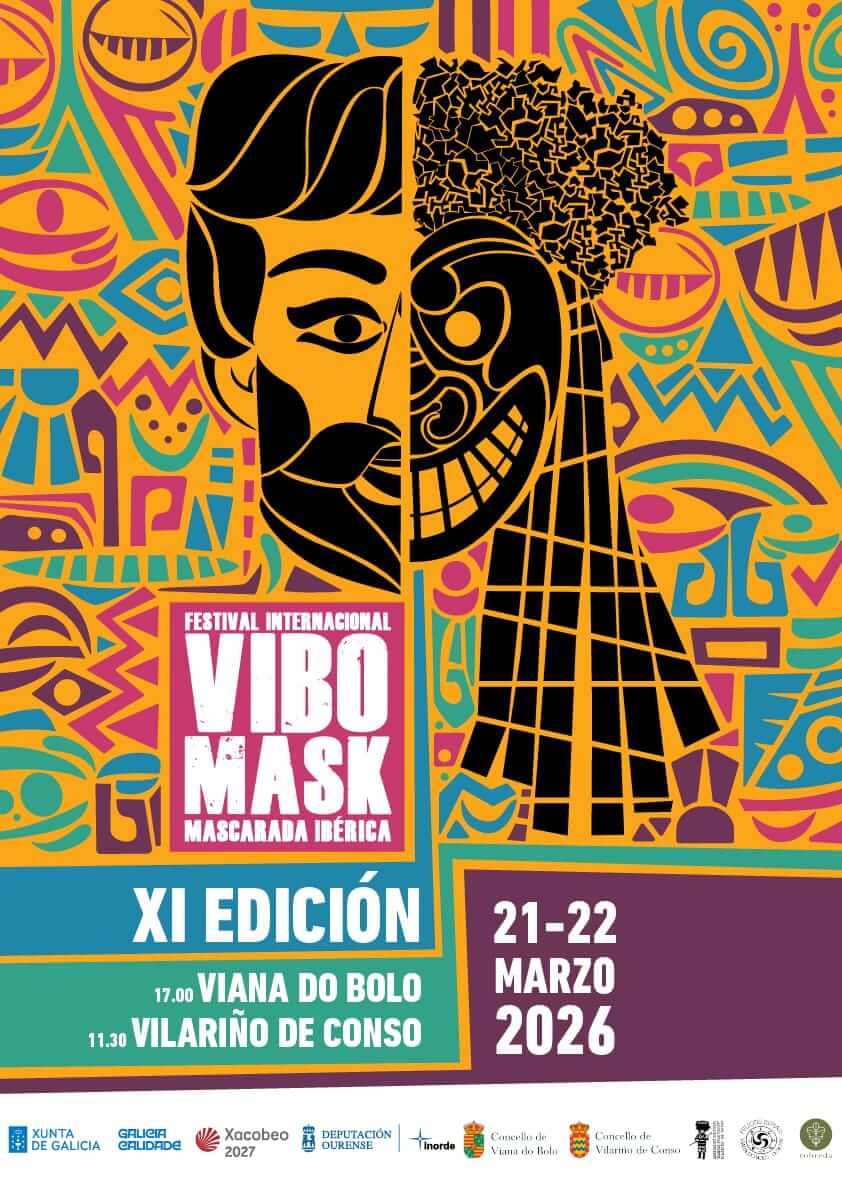
The 11th ViboMask International Iberian Masquerade Festival turned the Ourense municipalities of Viana do Bolo and Vilariño de Conso into the leading showcase for winter masquerades from across the Iberian Peninsula between 20 and 22 March 2026. Over three days, more than fifty groups and masked characters from Galicia, various Spanish regions and several areas of northern Portugal took to the streets, offering a unique overview of the richness and diversity of these inherited celebrations.
Professor M.ª Pilar Panero García, Director of the Chair of Studies on Tradition at the University of Valladolid, took part in this 11th edition of ViboMask with the lecture “Living Masks: Rituals, Performances and the Art of Mask‑Making”. Her contribution formed part of the ViBoCultura session held on Friday 20 March at the IES Carlos Casares, which opened the festival with a series of talks devoted to winter masquerades. Alongside her lecture, anthropologist Mario Moreno (Piornal) explored the meaning of the Extremaduran festival in “Jarramplas Behind the Mask: Festive Ritual in High Extremadura”, while Matamá (Laza) artisan Paco Diéguez delved into technical and aesthetic knowledge in “The Piliqueiro Mask: Craftsmanship and Tradition”. This dialogue between academic research, anthropological analysis and craft experience offered younger audiences a multifaceted vision of mask culture that complemented the festive side of ViboMask. The morning closed with a presentation by “Gari” meber the association “Toros y Guirrios” from Velilla de la Reina (León).
Conference content
In her lecture, Panero approached the mask as living heritage, analysing how it weaves together rites, rituals and contemporary performances in Iberian masquerades. She explained the anthropological difference between rite (the “why” of the symbolic act) and ritual (the technical “how” of its performance), as well as their role in community cohesion and the shaping of local memory.
She showed how today’s masquerades blend tradition, staging and new ritualities, in which participants do not simply reproduce a rite from the past but create subjective performances that enter into dialogue with it. She also highlighted the importance of craft labour in mask‑making, shaped both by historical movements such as Arts and Crafts and by the recent reappraisal of the popular, the rural and the traditional.


Links with the European project MASKS
The lecture forms part of the European project MASKS – “Unveiling the Arts and Works behind the MASKS”, co‑funded by the European Union and coordinated by the University of Valladolid. This project seeks to make mask culture more visible, to acknowledge its symbolic, cultural and economic value and to foster the involvement of local communities and institutional stakeholders in its safeguarding.
Contribution to the 11th ViboMask Festival
The participation of our MASKS project strengthens the academic dimension of the festival, offering audiences a critical reading of the heritagisation of masquerades in regions such as Castile and León and Galicia. Through this lecture, ViboMask XI is consolidated as a meeting point between university research, artistic creation and bearer communities, helping to deepen knowledge, appreciation and continuity of mask culture in the Iberian context. We were delighted to take part alongside young compulsory‑education students who live in a territory so rich in masks.
We would like to thank the pupils and their teachers for their attention and interest. Our thanks also go to Pedro Basalo Bembibre, organiser of the session, for his support, and to the festival team led by Jorge Domínguez Couso, “Minas”, president of the Robreda Association, for integrating the academic and outreach dimension in which MASKS is framed. In this way, the festival not only promotes tourism and economic activity in the area, but also stands as a platform for the study, recognition and transmission of traditions that remain in constant transformation.
Photos: Carlos G. Hervella, O Sil


