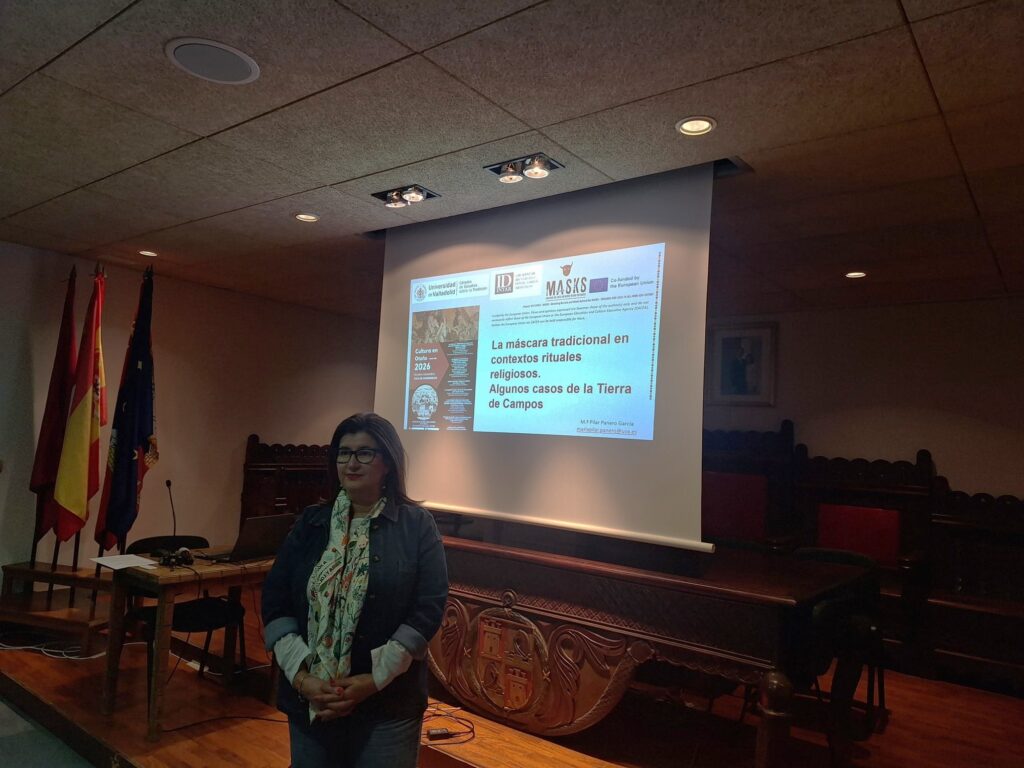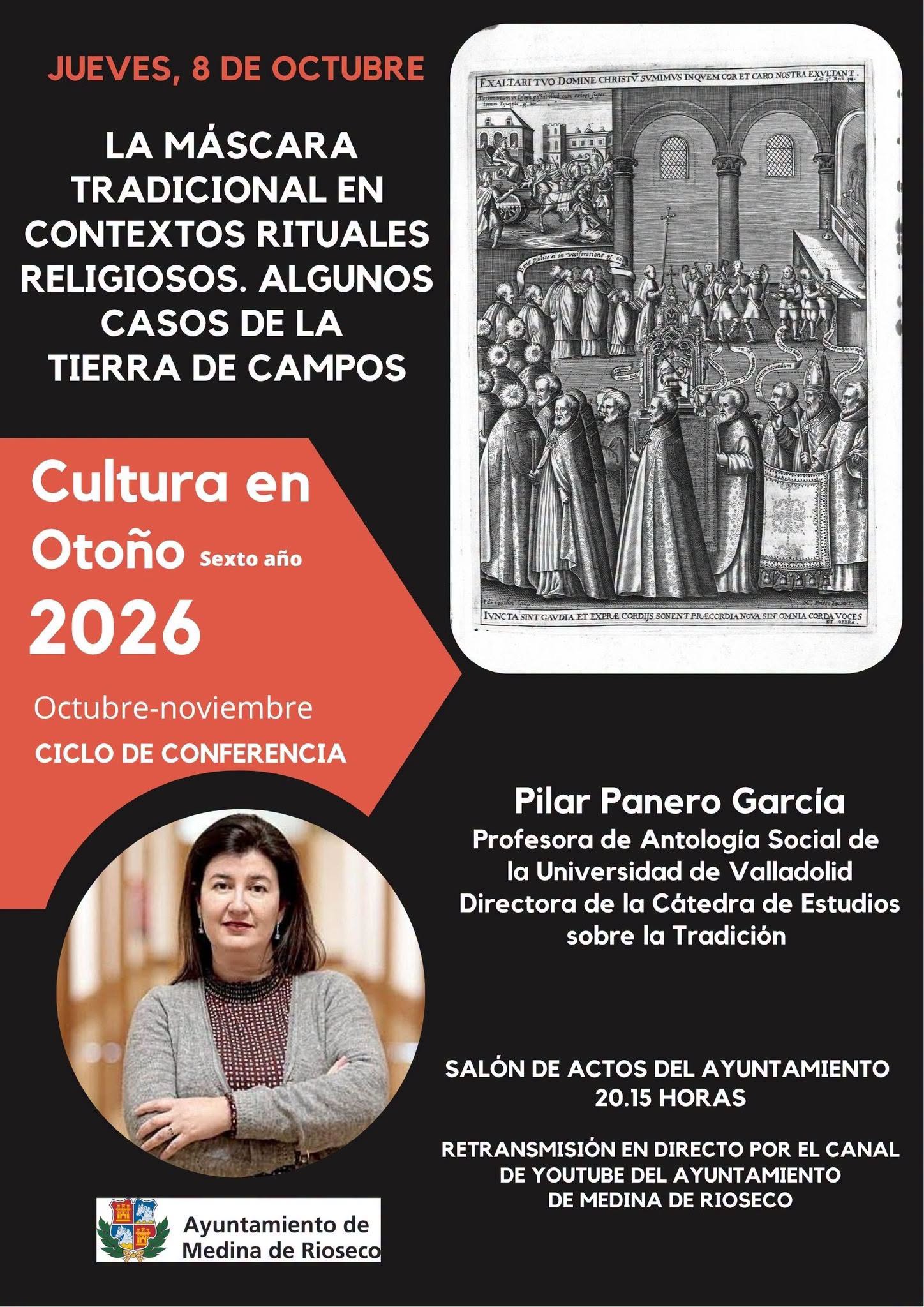
The lecture, held as part of the “Culture in Fall 2026” series organized by the Medina de Rioseco City Council, addressed the symbolic, devotional, and cultural heritage value of masks in the Holy Week and Corpus Christi processions. The lecture summarized a more extensive study co-authored with Professor Ramón Pérez de Castro, which will be published shortly and is affiliated with MASKS.
Pilar Panero García, professor of Social Anthropology at the University of Valladolid and director of the Chair of Studies on Tradition, delivered the lecture “The Traditional Mask in Religious Ritual Contexts: Some Cases from the Tierra de Campos,” which was part of the “Culture in Autumn” series organized by the Medina de Rioseco City Council.
The presentation offered a historical and anthropological perspective on the use of masks in religious celebrations during the Modern Age and challenged the notion that these elements were exclusive to Carnival or necessarily linked to transgression. On the contrary, the researcher demonstrated how masks were part of public, regulated, and devotional performances that helped make the sacred narrative visible and understandable during the Holy Week and Corpus Christi processions.
Using the examples of Medina de Rioseco, Becerril de Campos, and Laguna de Negrillos, Panero García reconstructed a ritual universe in which bodies, images, attire, and symbolic attributes combined to represent the sacred and encourage community participation in the celebrations.
One of the most notable examples was that of the Holy Sepulcher in Medina de Rioseco. During the Good Friday procession, twelve workers from the tanners’ guild carried the processional urn dressed as apostles, wearing albs, cinctures, wigs, and masks—also known as “rostros.” These elements were not intended to literally transform the bearers into the characters they represented, but rather to establish a symbolic mediation between the person and the role they played. In this way, the participants completed the sculptural scene of the Recumbent Christ, maintaining the religious decorum of the representation.
The lecture also focused on Becerril de Campos, where the Brotherhood of the Name of Jesus and the Holy Apostles—documented between 1661 and 1757—organized performances for the Feast of Corpus Christi. Its members portrayed the apostles, God the Father, Saint Sebastian, and other religious figures. The surviving records detail expenses for clothing, crowns, masks, and insignia, and note, in 1745, the restoration of twenty-one insignia, primarily faces or masks and diadems. These records shed light on the importance of material culture in the preparation and continuity of the performances.
Panero García explained that, during the Baroque period, the church and the street were part of the same ritual space. Processions extended the experience of the sacred through images, music, movement, costumes, and collective participation. From this perspective, the mask could help reinforce religious orthodoxy by making the characters recognizable and symbolically organizing the performance.
However, this relationship between masks and religiosity began to change in the mid-18th century. In 1757, an inspector condemned the masked processions in Becerril de Campos, labeling them “mojiganga.” Subsequent Enlightenment and ecclesiastical reforms intensified restrictions on certain dramatic performances, which were considered profane or superstitious. As a result, many processional masks disappeared, although the process was neither uniform nor immediate in all places.
The lecture concluded with a reflection on the relevance of these traditions today. Far from being mere vestiges of the past, traditional masks have taken on new meanings related to devotion, collective memory, local identity, and heritage preservation, without neglecting their potential as a form of spectacle. Their continuity, the speaker noted, depends on the ability of communities to preserve these practices, adapt them to new contexts, and pass them down from generation to generation, keeping alive the link between tradition, celebration, and cultural heritage.
The event took place in the auditorium of the Medina de Rioseco City Hall, which kicked off the “Culture in Fall 2026” lecture series. The series’ October and November schedule is dedicated to introducing the public to different aspects of culture and traditions. The lecture could also be viewed via a live stream on the Medina de Rioseco City Hall’s YouTube channel.