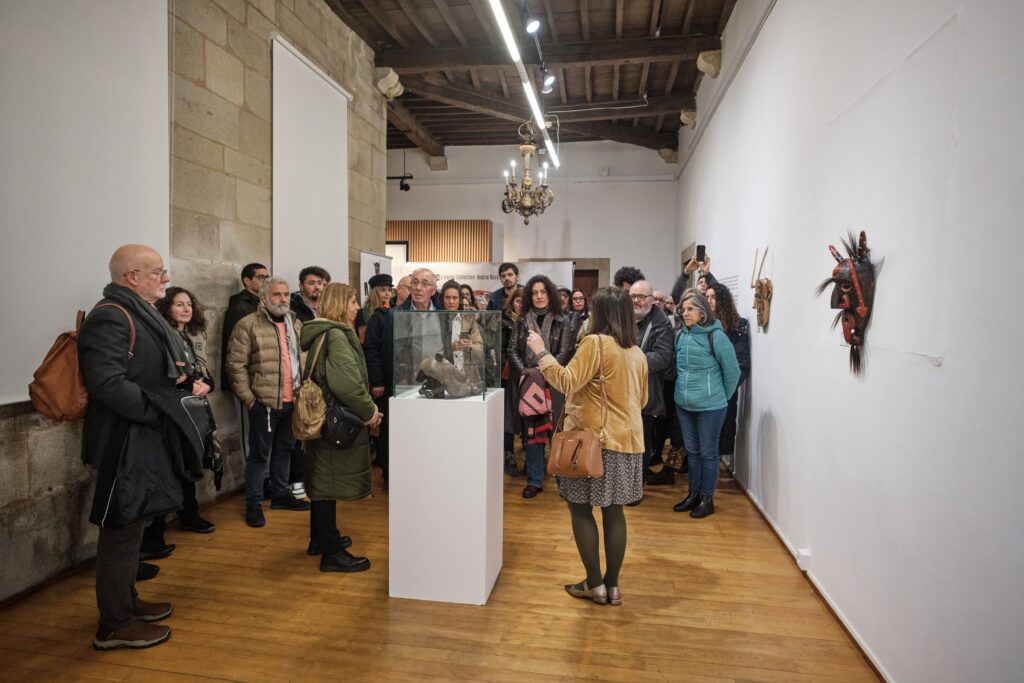
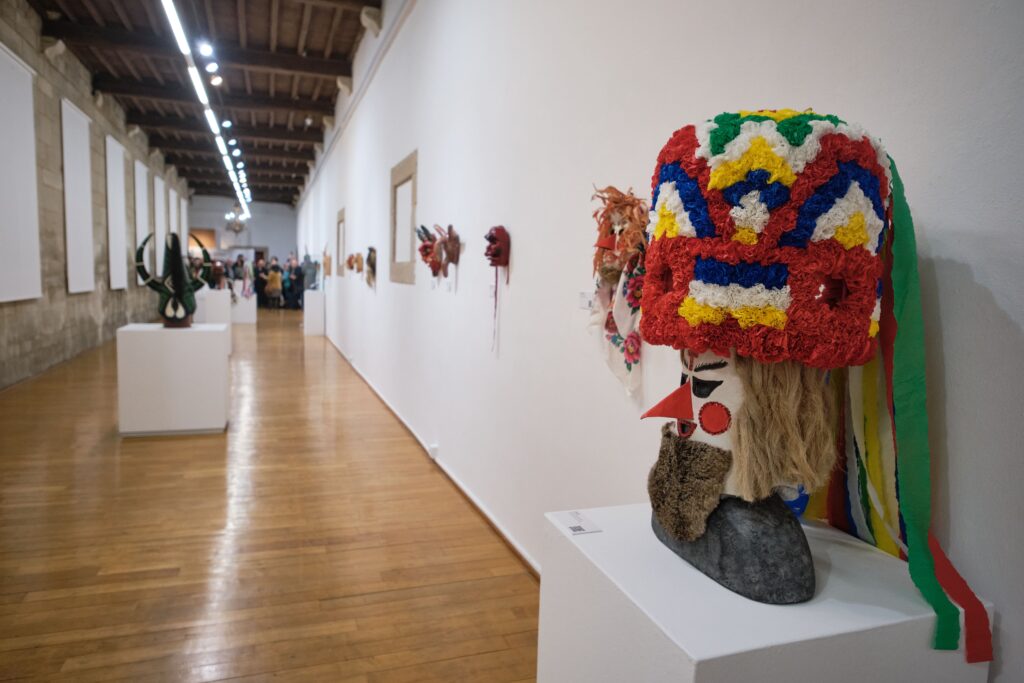
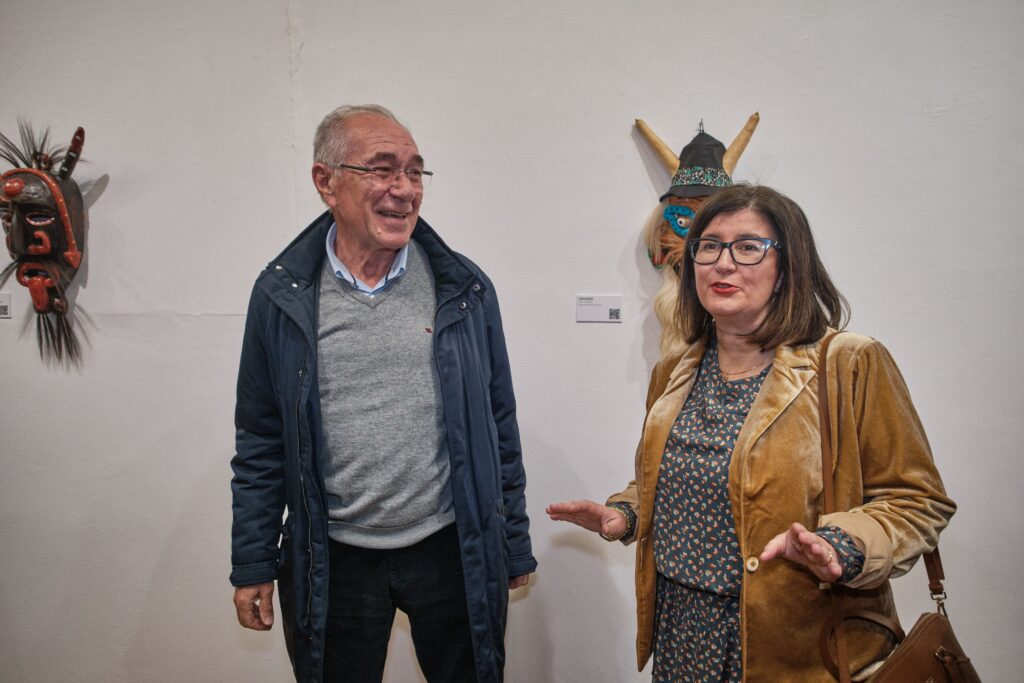
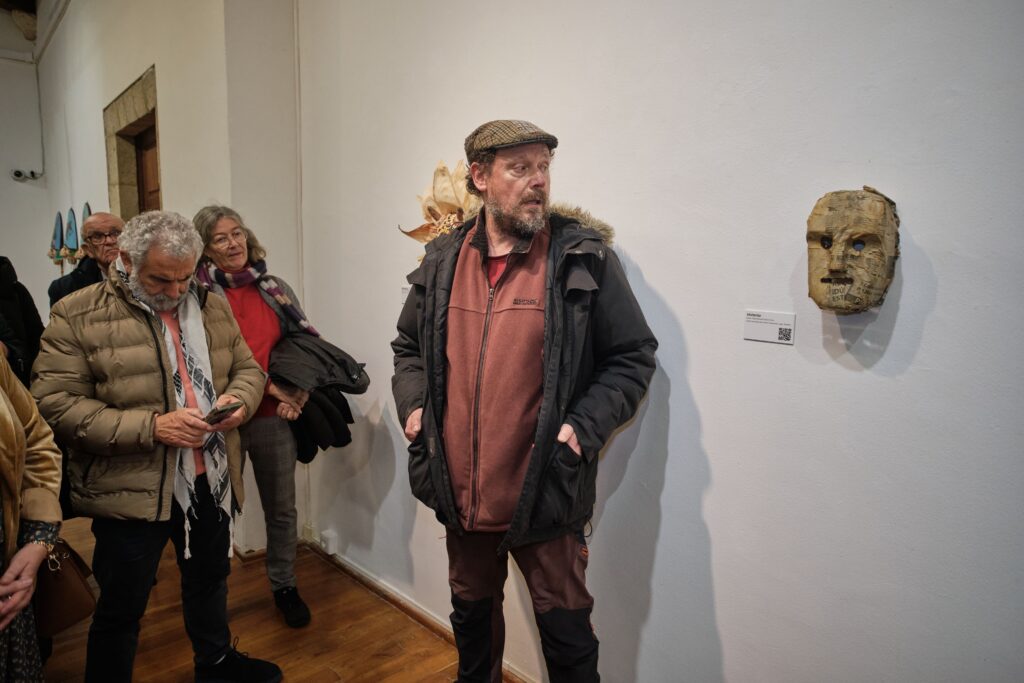
The Museo do Pobo Galego opened the exhibition MASKS. Alas y Viento Collection. Nacho Rovira II yesterday, Thursday, 29 January. This exhibition invites visitors to approach the world of masks as a universal cultural expression, present in festivals, rituals and theatrical performances from different periods and places around the world.
The initiative, promoted by the University of Valladolid through the Chair of Studies of Tradition, is coordinated and curated by Professor Pilar Panero, principal investigator of the European project Unveiling the Arts and Works behind the Masks, an Erasmus+ initiative supported by the European Education and Culture Executive Agency. The project involves lecturers from the Faculty of Arts, some of them members of the Research Group “Identity and Artistic Exchanges. From the Middle Ages to the Contemporary World” (IDINTAR), and is coordinated by the Department of Prehistory, Archaeology, Social Anthropology and Historiographical Sciences and Techniques. This edition expands and improves on the first version, which could be seen at MUVa until February 2025.
The exhibition consists of a carefully chosen selection of 54 masks from Romania, Italy, Portugal and Spain, the countries of origin of the MASKS project partners, all of them belonging to the private collection of collector and traveller Nacho Rovira, who has spent more than forty years gathering pieces of this mask-making art on four continents. These are joined by a dozen masks from the collections of the Museo do Pobo Galego, which complement the permanent exhibition devoted to the Galician Entroido.
In total, 66 pieces are presented, tracing the uses, times and meanings of masks and bearing witness to their universality. Visitors will see pieces from popular carnival, linked to winter festivities and traditional antruejos; masks used in religious celebrations such as Christmas, Holy Week or Corpus Christi; examples of Baroque court carnival and of the Commedia dell’Arte, associated with theatre and stage performances in early modern Europe; funerary masks, linked to rites of farewell, memory and the cycle of life and death; as well as contemporary and artistic masks, which show how these traditions remain alive and in constant reinterpretation.
The masks on display were created by artisans from Romania, Italy, Spain and Portugal, the countries that make up the MASKS project consortium. The exhibition’s official image is a collage of five masks designed by Gaetano Armenio, from Editrice L’Imagine, a project partner.
The opening was chaired by the president of the Board of Trustees of the Museo do Pobo Galego, Concepción Losada Vázquez, who stressed that the exhibition allows Nacho Rovira’s collection to establish a close dialogue with Galician ethnographic heritage and with the traditions of the Entroido, one of the most significant festive expressions of Galician culture. Through these pieces, it becomes clear that even in a technological and constantly changing society, the symbolic power of these objects remains deeply relevant and helps strengthen community bonds. In the case of the Galician Entroido, their presence is essential, as they act as a link between past and present in a celebration that combines tradition, creativity and social critique.
Conchita Pérez Gil, conservator of Alas y Viento, stated that the pride of the people is a powerful emotion, and communities cling to their traditions, perhaps driven by the memory of their ancestors; and that perhaps, through art in all its forms, they have used and still use masks as a source of inspiration and a means of expression. She pointed out that both Nacho Rovira, the soul of the collection, and the entire team were particularly enthusiastic about this new collaboration with the University of Valladolid and with the Museo do Pobo Galego, which is also deeply committed to the task of preserving and disseminating popular culture and art.
Professor Pilar Panero explained that the MASKS project is being developed with the aim of making the work of artisans and artists linked to the world of masks more visible. Although the two categories are not used as synonyms, their boundaries are blurred, especially from the perspective of an anthropology of art that has moved beyond traditional notions of primitivism and ruralism. These creators engage with different mask-making contexts and help to enhance the value of masks as cultural, symbolic and economic capital for different groups, both traditional and institutional. Today, masks continue to be created for recreational, ritual and aesthetic purposes, acting as visual supports for traditions in transformation. Their making brings together inherited materials and techniques with contemporary innovations, preserving — and sometimes reinterpreting — the aesthetic categories transmitted by tradition.
Panero highlighted Nacho Rovira’s generosity in once again loaning the exhibition and added that she finds it encouraging that he has been willing to incorporate pieces made in the territories where the MASKS team works — the tafarrón of Pozuelo de Tábara, the máscaro of Ousilhão, the zangarrón of Montamarta, the carocho of Constantim, the lole of Brașov, Transylvania, Romania, the cornuto and the capra of Aliano and the canhoto (diabo) of Cidões — along with other pieces from other territories that they also consider extraordinary.
Photographs by Roberto de la Torre
We would like to thank the Museo do Pobo Galego for their warm welcome and Nacho Rovira for his generosity and love of masks. We are very honoured to be working with both of them.
The open-access catalogue, available free of charge in English, Spanish and Galician, can be downloaded from the UVa institutional repository: https://uvadoc.uva.es/handle/10324/82265