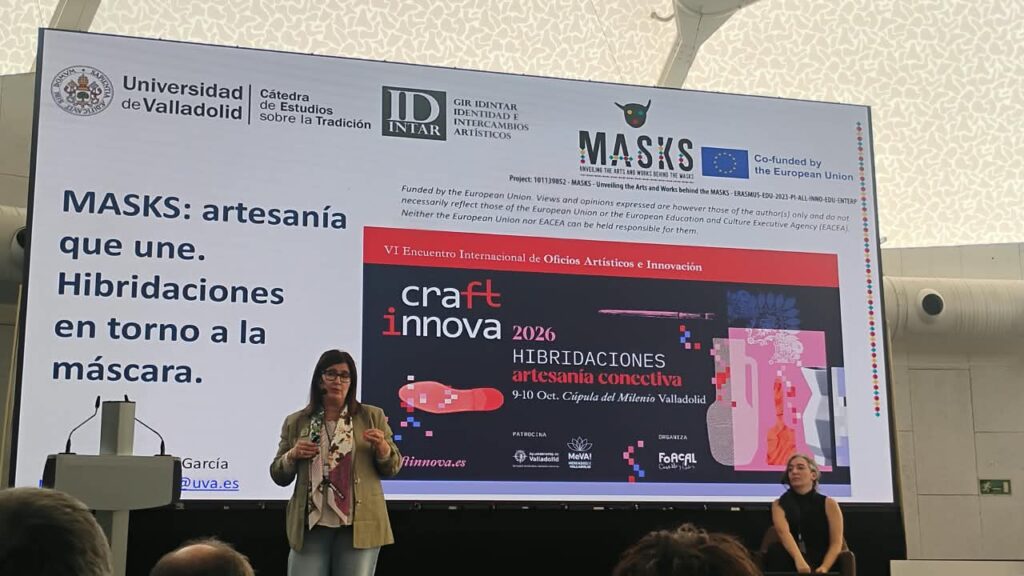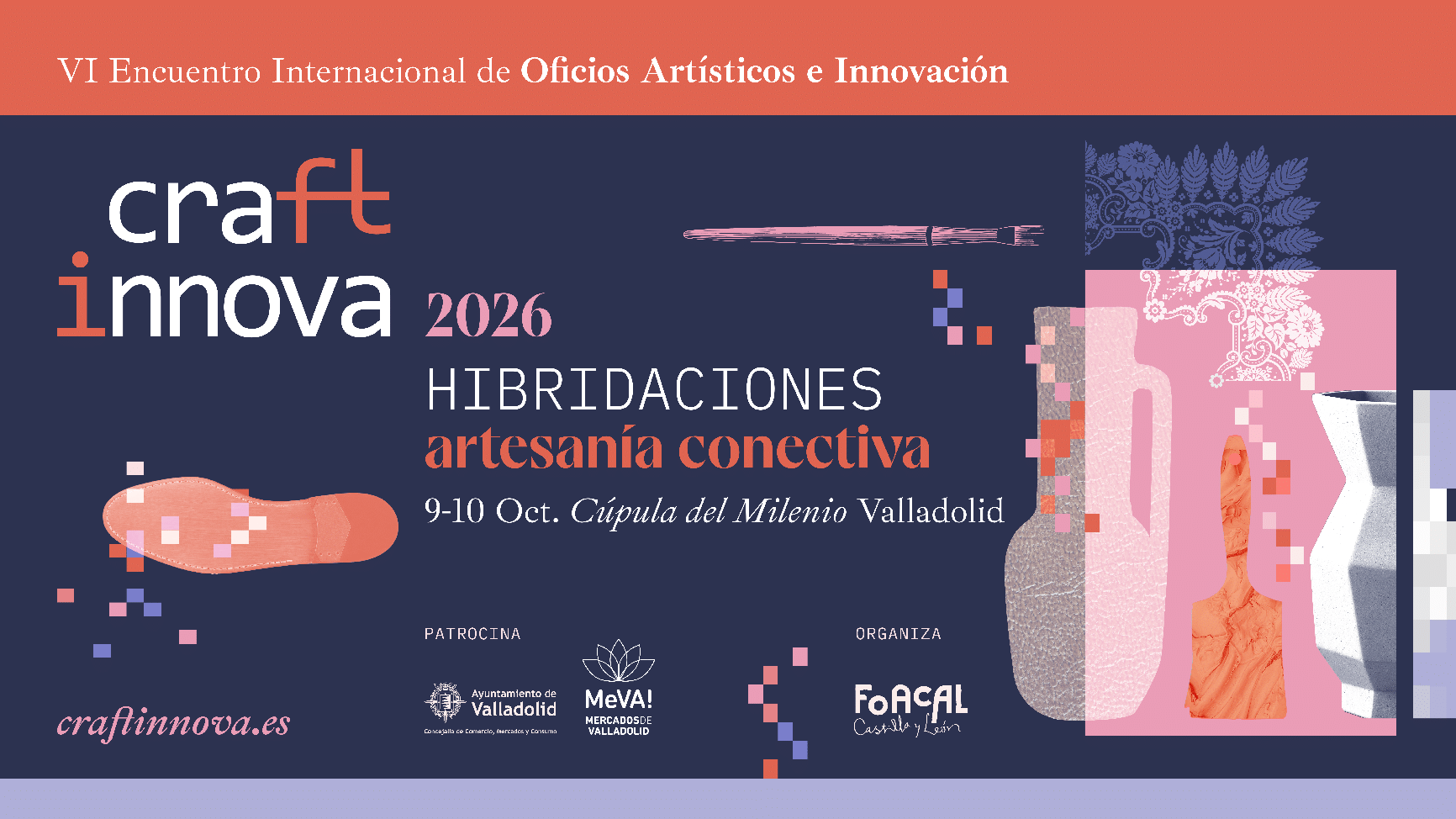
The European project took part in the 6th International Meeting on Artistic Crafts and Innovation, organised by CEARCAL-FOACAL, a MASKS partner organisation, on 9 and 10 October at the Millennium Dome in Valladolid.
The European MASKS project took part in CraftInnova 2026, a leading forum for craftsmanship, creativity and innovation. The project’s presence at the 6th International Meeting on Artistic Crafts and Innovation has placed masks and masquerades at the heart of the dialogue between traditional knowledge, specialised training and new opportunities for development within the craft sector.
The fair, held on 9 and 10 October at the Millennium Dome in Valladolid, is organised by the Regional Centre for Crafts of Castile and León (CEARCAL) and the Federation of Craft Organisations of Castile and León (FOACAL), one of the partner organisations of the MASKS project. This partnership reinforces the coherence of the project’s participation in an event dedicated to highlighting innovation, creativity and the future of the arts and crafts.
The talk took place on Friday 9 October and was given by María Pilar Panero García, from the University of Valladolid, under the title ‘MASKS: craftsmanship that unites. Hybridisations surrounding the mask’. The presentation explored the mask as a handcrafted creation and a cultural expression steeped in symbolism, linked to the communities that make and use them in celebrations and ritual performances.
Craft, research and innovation
CraftInnova brought together a wide-ranging programme of talks, round-table discussions and workshops on contemporary craft, design, digital technologies, sustainability and training. The programme included activities relating to textiles, ceramics, hybrid sculpture, 3D printing, digital fabrication and the management of craft workshops. Within this context, MASKS offered a perspective centred on the relationship between cultural heritage, craft production, research and training.
Taking part in CraftInnova provided an opportunity to raise awareness of the project’s objectives amongst professionals, students, researchers and members of the public with an interest in the arts and crafts. MASKS advocates an approach to masks and masquerades that views them not merely as objects, but as creations in which techniques, knowledge, memories, social relationships and community identities converge.
A European partnership
Funded by the European Union through the Erasmus+ programme, MASKS brings together a transnational collaboration between universities, vocational training institutions, craft organisations, research centres, businesses and cultural organisations in Spain, Italy, Portugal and Romania. The University of Valladolid is participating in the project alongside, amongst other institutions, FOACAL/CEARCAL, the Centro de Formação Profissional para o Artesanato e Património de Coimbra, the Academia Ibérica da Máscara de Bragança and various European academic, cultural and business organisations.
The project’s objectives include fostering the exchange of knowledge between higher education, vocational training and the business sector; facilitating the learning of creative techniques and processes linked to craftsmanship; and promoting innovation, sustainability and entrepreneurial skills related to heritage products.
Heritage and rural development
MASKS also works to raise the profile of masks and masked processions, promote their study and cataloguing, and raise awareness of the importance of safeguarding and disseminating them. The project highlights the role of craftspeople and the communities that preserve these traditions, particularly in rural areas where these cultural expressions constitute a cultural, social and economic resource of the highest order.
Participation in CraftInnova confirms the importance of linking traditional craftsmanship with forums for innovation and knowledge transfer. The organisation of the fair by CEARCAL-FOACAL, a partner of MASKS, has also provided an ideal setting for sharing the project’s progress and highlighting that heritage conservation can go hand in hand with training, creativity, entrepreneurship and regional development.
Panero took the opportunity during the presentation to thank the MASKS partners for their hard work and commitment to the project, the main achievement of which is the online training and the mobility programmes carried out in July 2026. He also highlighted that the value and scope of MASKS are being expanded thanks to complementary initiatives such as CraftInnova, organised by CEARCAL-FOACAL, and praised the involvement and contribution of Félix Sanz, Mar Cano and Verónica Coca in promoting craftsmanship, innovation and collaboration amongst professionals in the sector.
Available at: https://www.youtube.com/watch?v=hB_DZ6aU34k
Download the programme of events via the following link: https://unveilingthemasks.uva.es/wp-content/uploads/2026/10/Programa_CraftInnova_A4.pdf