
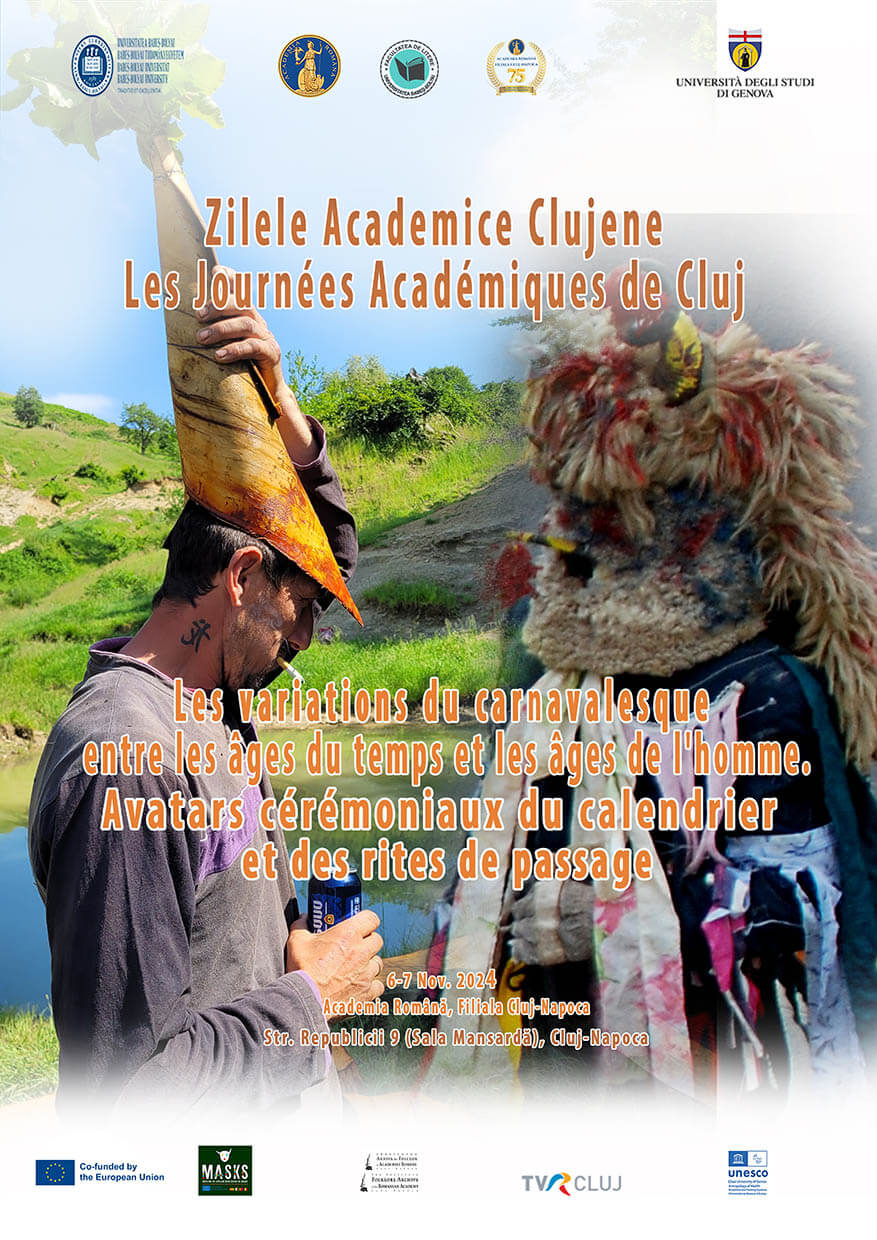
The conference, held on November 6-7, 2024, at the Romanian Academy, Cluj-Napoca Branch, organized by PhD. Ileana Benga and PhD. Bogdan Neagota, brought together experts to explore masks and carnivalesque traditions in their ritualistic, symbolic, and cultural contexts. Through presentations, discussions, and ethnographic films, the event examined how these practices connect generational dialogues, rites of passage, and societal transformations.
The first day began with sessions moderated by Sonia Maura Barillari (University of Genoa) and Bogdan Neagota (Babeș-Bolyai University). Researchers discussed masking symbolism and its historical and cultural dimensions. Highlights included Antonio Guerci's analysis of health symbolism in Maschere della salute and Vita Santoro's insights into diachronic masking traditions in Basilicata. Sandra Ferracuti examined intergenerational dialogues in the Carnival at Satriano di Lucania, while Sophie Gleiges explored the adaptation of carnival traditions during war in Ukraine. Alin Rus and Gabriel-Cătălin Stoian presented masks as cultural artifacts, emphasizing Romanian traditions from Heleșteni and Brănești. The day concluded with ethnographic films vividly portraying these practices.
The second day opened with Florin-Vasile Pop (Technical University of Cluj-Napoca) moderating a session blending cultural and visual anthropology. Francesco Marano showcased the Carnival of San Mauro Forte, while Daniel Radu Pop and Florin-Vasile Pop highlighted Vasile Șușca’s artistry in Măști și chipuri. Ioan Apostu documented carnivalesque traditions in Caraș-Severin, showcasing rural Romania's unique heritage.
In the afternoon, discussions, moderated by Bogdan Neagota, explored artistic and literary implications of masking. Laura Muncaciu analyzed vocal identity in The Rite Progress, Rareș Zaharia traced mask usage in early 20th-century opera, Gelu Teampău examined their role in comic books, and Victor Horațiu Troșan explored lyrical depictions in Epodon Liber.
The final session, moderated by Gabriel-Cătălin Stoian, focused on Romanian ethnographic practices. Vasile Mathe studied Fășangii from Cetea, Alba, while Bogdan Neagota presented Le Cerf, a Romanian ritual mask. Ileana Benga explored masked characters in the Căluș ritual, accompanied by films of Romanian spring traditions.
Organized by the Folklore Archive of the Romanian Academy, the Faculty of Letters of Babeș-Bolyai University, and the UNESCO Chair on Anthropology of Health, the conference bridged traditional and modern interpretations of the carnivalesque, enriching understanding of its cultural resonance.


