IAFAR - Institutul Arhiva de Folclor a Academiei Romane
The Folklore Archive of the Romanian Academy (FARA)is one of the first institutions in Romania for the collection and preservation of the local cultural patrimony, created on the purpose of harvesting documents of oral tradition from the entire Romanian-speaking lands, as early or as late as 1930, by initiative of ION MUȘLEA, at the incentive of Romanian Academy. The over 90 years of existence of the institution have witnessed many different stages, when it ceased belonging to the Romanian Academy and transferred to museums, universities and other institutions. Since 1949 it started adding permanent collections of Hungarian- and Saxon-speaking documents of oral tradition (music and narratives). In 1964 and 1971 further institutional changes bring the FARA back to the Romanian Academy, where in 1990 it became the institute of today.
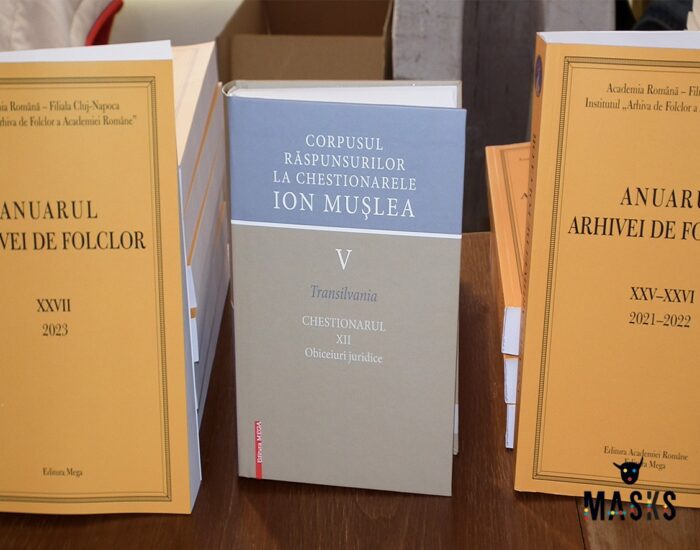
At the beginning, the mere collection of documents from villages, adjoining peasants and local intellectuals, with errant craftsmen and musicians, and with the occasional objectual description of various artefacts and respective technologies (later to be hosted in the Ethnographic Transylvanian Museum) were meant as a public repository of cultural memory. Its open end towards society was intended to be the FARA Yearbook, which has been published and internationally spread, in three series: 1930-1948, 1980-1996, and 2021-present (27 volumes). A comprehensive bibliography of Romanian folklore had the same purpose of disseminating as wide as possible the local traditional narratives, customs and music.
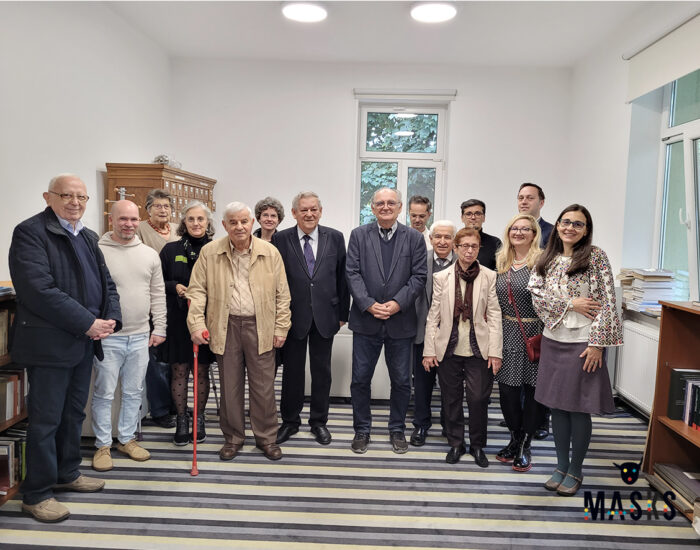
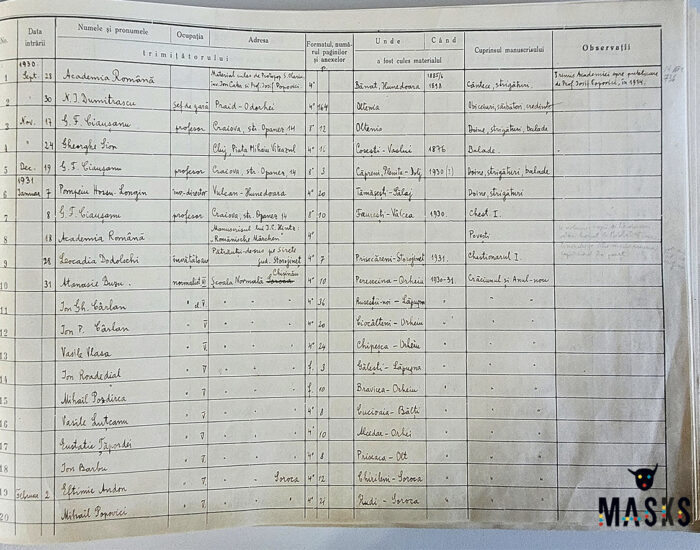
With the development of the latest technologies, a wide initiative of digitisation of the extant archival materials has resulted in important collections of digital materials, available to researchers upon request. The respective catalogues are available online. Only recently (2020) has the Romanian Academy approved to open its folklore collections in both Romanian Folklore Institutes. In Cluj-Napoca, generalised access is merit of Director Prof. Mihai Bărbulescu. Therefore, the FARA institute is yet to develop the necessary arms to reach society and give back to it the patrimony collected in the last hundred years of local folklore studies. In this respect, we view the participation of our institute in the MASKS international project and consortium as the perfect occasion to learn, develop and implement such opening, not only towards the local society, but also towards the European family. FARA has opened its doors and scientific content in recent years, by hosting jointly the ”Open Days” (since 2021) together with the enduring ”Annual Conferences of the FARA”. Wider public engages with the archives, learning about the history of the institute, the written funds and catalogues, the old technologies of the past: phonographs, wax cylinders, magnetic tapes, black-and-white negatives, typewriters. The on-site presentation gives tangible connections to the past, fostering greater understanding and appreciation of broad folklore.
IAFAR Institutul „Arhiva de Folclor a Academiei Române” The Folklore Archive of the Romanian Academy Institute Address: 59 Republicii St., 400489 Cluj-Napoca ROMANIA
Funded by the European Union. Views and opinions expressed are however those of the author(s) only and do not necessarily reflect those of the European Union or the European Education and Culture Executive Agency (EACEA). Neither the European Union nor EACEA can be held responsible for them.
Project: 101139852 - MASKS - Unveiling the Arts and Works behind the MASKS - ERASMUS-EDU-2023-PI-ALL-INNO-EDU-ENTERP
To provide the best experiences, we use technologies such as cookies to store and/or access device information. Consenting to these technologies will allow us to process data such as browsing behaviour or unique IDs on this site. Not consenting or withdrawing consent may adversely affect certain features and functions.
Functional
Always active
Technical storage or access is strictly necessary for the legitimate purpose of enabling the use of a specific service explicitly requested by the subscriber or user, or for the sole purpose of carrying out the transmission of a communication over an electronic communications network.
Preferences
L'archiviazione tecnica o l'accesso sono necessari per lo scopo legittimo di memorizzare le preferenze che non sono richieste dall'abbonato o dall'utente.
Statistics
Technical archiving or access that is used exclusively for statistical purposes.Technical storage or access is used solely for anonymous statistical purposes. Without a subpoena, voluntary compliance by your Internet Service Provider, or additional records from third parties, information stored or retrieved for this purpose alone cannot usually be used for identification purposes.
Marketing
Technical storage or access is necessary for the legitimate purpose of storing preferences that are not requested by the subscriber or user.