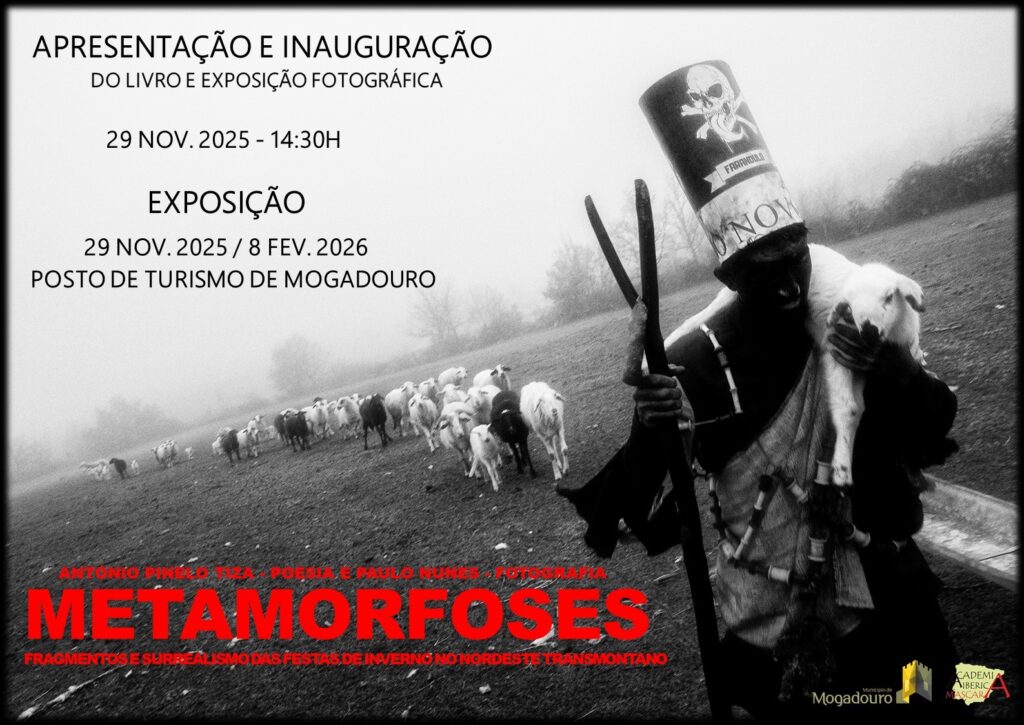
The Georges Dussaud Photography Center inaugurates the exhibition “Metamorfoses,” a dialogue between the poems of António Tiza and the black-and-white photographs of Paulo Nunes, dedicated to the winter festivals and masked carnivals of Northeast Trás-os-Montes. The show was previously exhibited at the Mogadouro tourist office.
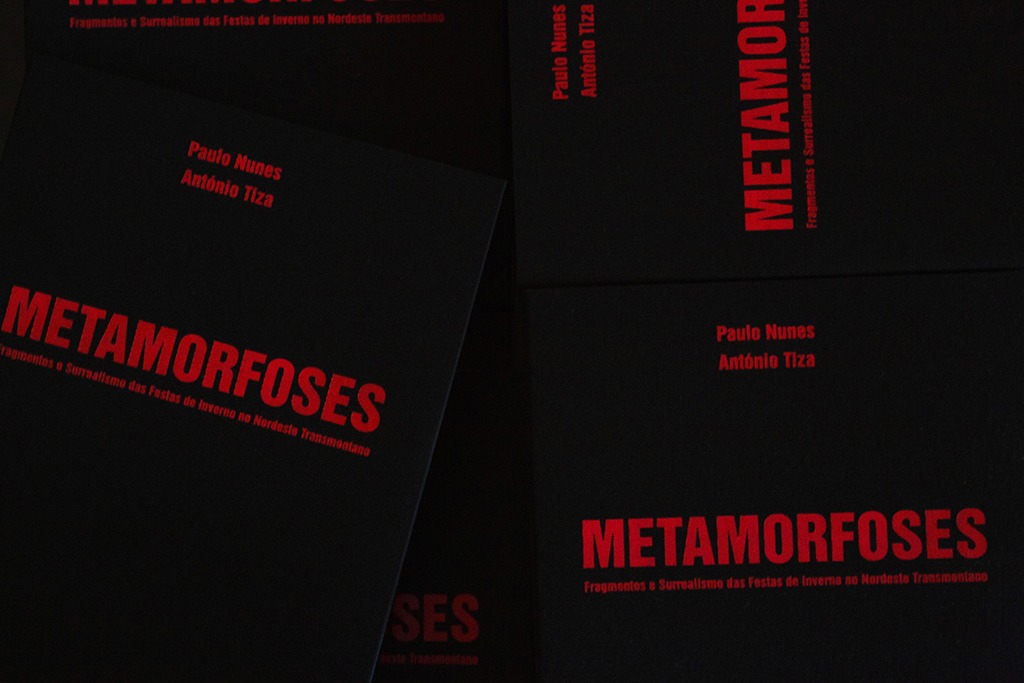
The exhibition features a selection from the book Metamorfoses. Fragmentos e surrealismo das festas de inverno no Nordeste Transmontano (2025), with a prologue by Paula Godinho and an epilogue by André Gago. It is a meticulously crafted edition published by Carviçais' Lema d'Origem publishing house.
The “Metamorfoses” project brings together masked characters and ritual sequences that emerge during the long winter cycle, from All Saints' Eve to Holy Saturday, with special attention to the villages and festivals of the Northeast Transmontano region. Paulo Nunes' images and António Tiza's poems guide us through universes such as the devils, goats, and left-handers of Cidões (Vinhais), the old men and women of Bruxó and Vale de Porco, the caretos of Aveleda, the farandulos of Tó, the chocalheiro of Bemposta, the caretos of Torre Dona Chama, or the grand communal tables of Grijó de Parada and Parada de Infanções, among many other celebrations.
In the words of anthropologist Paula Godinho, the book and exhibition reveal how, in the heart of winter, “encapsulation is broken by strong ceremonial moments of great intensity, frequented by masked characters, because culture does not tolerate closure and the absence of exchanges.” These winter festivals and carnivals, with their caretos and chocalheiros, old men and women, daring scenes, music, dance, abundant meals, and ritual excess, sketch a “world upside down” where popular laughter and transgression allow the social order to regenerate.
Paulo Nunes' photographs propose a renewal in the way of viewing these festivals and reinstall their mystery. In black and white, exploring all the nuances of the dramatic spectrum of people and places, his subjective camera positions itself as an almost clandestine observer: it does not limit itself to producing aesthetic objects but constructs a true visual “reportage” of the celebrations, amid the smoke, mist, and winter rain, always opening the possibility of “being there” beyond the image itself.
The volume's epilogue, signed by André Gago, highlights the power of António (Pinelo) Tiza's poetic word. For Gago, the author—better known for the rigor of his ethnographic studies—achieves a radical gesture here: he transforms the texts into the festival itself, recovering a poetic tradition tied to ritual, akin to Orphic poetry, propitiatory dithyrambs, or hymns that, as in ancient Greece, gave rise to foundational epics and tragedies. The poems do not “explain” the festivals; they pulse with the beat of ancestry and restore that world to us in a contemporary key.
Paula Godinho also recalls that these celebrations have undergone an intense transformation process in recent decades: lost festivals resurface from memory, forms and meanings are reinvented, and villages reactivate their role amid strong emigration and depopulation. Winter masquerades and carnivals, now also integrated into festive and tourist circuits, continue to fulfill a social function of encounter between those who stayed and those who return each year to don the masks and shake the bells.
Practical Information
Venue: Georges Dussaud Photography Center, Paulo Quintela Building – 1st floor, Rua Abílio Beça, no. 75–77, 5300-011 Bragança, Portugal.
Dates: From February 13, 2026 (check exact duration with the organization).
Visiting Hours: Tuesday to Sunday, 9:00 a.m. to 12:30 p.m. and 2:00 p.m. to 5:30 p.m.; closed Mondays.